
Getting Your First Job. Everything You Need to Know.
Have you ever felt like everyone around you knows something you do not, and you somehow missed the memo? Getting your first job can feel a lot like that. Maybe you have a parent or mentor giving you great advice. Or maybe you are left to figure this out on your own. Either way, most teens and young adults need to know this stuff when it comes to landing their first job, and most are not accessing this information all in one place.
Searching for your first job involves a lot of practical considerations. You might not have a car, reliable transportation, or much free time. You are also navigating the realities of who is actually hiring and whether they will consider someone with no work experience. Add in the employment and hiring process itself, the applications, the interviews, the paperwork, and it can feel like a lot of moving pieces coming together all at once.
It is. But it is also a puzzle that can be solved. And it gets a lot easier when you know the tips and tricks before you start.
So here are the tips and tricks you need, all in one place. By the end of this article, you will know exactly what to do, where to start, and how to give yourself the best shot at landing your first job.
To be forthright, some of these tips will be more relevant than others depending on your personal circumstances, including where you live, your transportation situation, and what employers are near you. Use what applies for you, and skip what does not.
Take a seat and get comfortable. I will try to be brief, but I also want this to be thorough so you can get all the information you need to get started.
Here is what will be covered:
Step 1. Get Yourself Organized. The practical prep work that makes everything else easier.
Step 2. Job Search Strategies. How to find jobs that are realistic for your situation and experience level.
Step 3. Applying. How to apply for jobs.
Step 4. Making a Great First Impression. Preparing for and nailing a job interview.
Step 5. You Got a Job. What Is Next? Onboarding, paperwork, paychecks, and what to watch out for.
Step 6. How to Keep a Job Once You Have One. Showing up, doing the work, and being someone your employer can count on.
Note: While this guide is written step by step, real life job hunting is non-linear. You might be gathering your documentation (Step 1) while simultaneously asking friends for referrals (Step 2). Treat this as a roadmap rather than a rigid sequence.
Step 1. Get Yourself Organized
When applying for your first job, there will be a lot of stuff you need to have in place, and without it you will not make it very far in the process. So do yourself a favor and get organized first.
Using a master job application as your guide (search “master job application template,” there are countless free ones online), do some research for your age and area, get your references ready, clean up your social media, and make sure you can be contacted. The application process for most jobs is relatively the same. You will be asked for the same basic information from each of them. It will save you a lot of time and trouble if you know it before you start so you are not scrambling mid-application.
Here is what to have ready before you start applying.
Your contact information. Know your full legal name, address, phone number, and email address. Make sure your email is professional and that you check it regularly. If you do not have a cell phone, set up a Google Voice number so you can at least check voicemails and text messages. Set up your voicemail greeting if you have not already. Many people either have no voicemail set up, or worse, have something unprofessional recorded. A simple greeting is all you need: “Hi, you have reached your name. Please leave a message and I will call you back as soon as possible.”
Documentation. You will need a copy of your Social Security card, birth certificate, and possibly your driver’s license or state ID. You will not need these to apply for a job, but you will need them once a job offer is made. Locate these documents before you start applying so you are not scrambling later.
Other logistics. If you are under 18, depending on where you live, you may need a work permit before you can legally start a job. Roughly 40 states require them for minors under 18. Work permits are usually obtained through your school. Search your state name plus teen work permit to find out what is required where you live. Also research whether you meet the minimum age requirement for the jobs you are interested in before you start applying.
Know your availability. Before filling out any application, know exactly when you are available to work. Think through your school schedule, any sports practices or activities, and any other regular commitments. Be as flexible as you honestly can. The more availability you offer, the more attractive you are as a candidate. If you are under 16, federal law limits how many hours you can work. You cannot work before 7am or after 7pm on school nights, and no more than 3 hours on a school day. Your state may have additional restrictions. Check your state’s Department of Labor website for specifics.
References. Most applications ask for two or three professional references, though many will accept personal references too. Good references for teens include teachers, coaches, school counselors, religious leaders, neighbors, or family friends. Not your parents, siblings, or friends. Always ask their permission before sharing anyone’s name and contact information. Have each reference’s name, phone number, email address, and relationship to you ready before you start applying.
Your digital footprint. Before you apply anywhere, search your own name online and review your social media profiles. Employers do check. Make anything you would not want a hiring manager to see private or delete it. This includes photos, posts, comments, and usernames. Ensure your online presence does not prevent an employer from considering hiring you.
Step 2. Job Search Strategies
Now that you are organized, it is time to start looking and applying for your first job. Most people do not find a job through a single approach. The more strategies you try, the better your odds. Some of these will work better for your situation than others. Use whichever job search strategies apply to you and skip what does not.
A quick note on the current job landscape. As minimum wages have risen in recent years, some employers have become more selective about entry level hiring, preferring applicants who already have some experience. This is hitting harder in some states than others. It does not mean you cannot get a job without work experience. It means you may need to be more strategic about where you apply and not get discouraged if it takes longer than expected.
Start with what is close by. If you do not have a car or reliable transportation, geography is going to be one of the most important factors in your job search. Look at businesses within walking, biking, or scootering distance of your home or school. Check if there is a bus line that runs near places you could work.
Tell everyone you know. Tell family members, friends, neighbors, teachers, coaches, pastors, and anyone else you trust that you are looking for a job. Most first jobs come through people you already know. That is called networking, and it is one of the most effective job search strategies at any level. Find out where your friends and peers are working. If it sounds like somewhere you would want to work too, ask if they would be willing to introduce you to their manager. A friendly introduction from a current employee can go a long way.
Job fairs and hiring events. Many communities, schools, and shopping centers host job fairs where multiple employers are in one place looking to hire on the spot or very shortly after. Search your city name plus job fair or hiring event and you will find ones near you. These can be worth attending, but you need to arrive prepared. Dress as if it is a job interview. Bring copies of your resume. Get the hiring manager’s name and follow up with a thank you email.
Timing. If you are looking for a summer job, start your search by early spring. Many employers start hiring in March and April for summer positions. Do not wait until the week before school gets out. Summer jobs at camps, parks, pools, amusement parks, and seasonal businesses can fill up fast.
Places that are great for a first job. Not every company is equally likely to hire someone with no experience. But these are the business types that are more likely to hire a first-time worker.
Food service. Fast food chains, local diners, coffee shops, and ice cream shops. Roles include cashier, server, host, and kitchen staff.
Grocery stores and retail. Big box stores, grocery chains, and mall retailers. Roles include cashier, stocker, cart attendant, and personal shopper.
Movie theaters. Box office, ticketing, concessions, and cleaning.
Summer camps and recreation programs. Counselor, coach, and program aide roles.
Sports parks and recreation centers. Referee and umpire positions, concession stands, and front desk roles.
Amusement parks, indoor entertainment venues, and seasonal attractions. Ride operator, ticket sales, food service, and guest services hosts.
Libraries. Page and shelving assistant roles.
Warehouse and fulfillment centers. Picking, packing, stocking, and sorting roles.
Neighborhood jobs. Babysitting, lawn care, dog walking, and house sitting.
Car washes. Towel drying, vacuuming, and detailing.
Step 3. Applying
Once you have a list of places to apply, it is important to understand that it can take a while to get hired. Be patient and keep at it. Many people with no work history feel discouraged during the application process. Understand that every person who has ever had a job applied for their first job with no work history. Every single one. Do not let it stop you from applying. In fact, the sooner you get that first job, the sooner you start building the work history that will make every future application easier.
Not having work history does not mean you have nothing to offer. There are things you can do during the application process itself to set yourself apart from other candidates.
Your resume. When you are just starting out, a functional resume works better than a traditional one. A traditional resume lists your work history in order, which is not helpful when you do not have any. A functional resume leads with your skills, strengths, and relevant experience instead, organized by what you can do rather than where you have worked. Think sections like Leadership, Communication, Reliability, or Community Involvement, each filled with examples from school, sports, volunteering, and life.
For the work history section, think broadly. Babysitting, mowing lawns, volunteering, sports teams, clubs, school activities, all of it counts.
A word of caution on resume templates. They can look polished but are often difficult to edit and adapt. A simple, clean document you can actually control is better than a beautiful template you cannot modify without breaking the formatting.
When possible, customize your resume for each job you apply for. Read the job posting carefully and note the specific words and skills the employer uses. Work those words into your resume where they apply. Many employers use software called an Applicant Tracking System, or ATS, to scan resumes before a human ever reads them. If your resume does not contain the right keywords from the job posting, it may never make it to a real person. AI tools like ChatGPT can help here. Paste the job posting in and ask it to identify the key words and phrases, then work those into your resume.
Walk in and ask. For retail stores, restaurants, and fast food, walking in and asking if they are hiring can still be an effective strategy. Is it old school? A little. But it can work. The person doing the hiring may have gotten their own first job exactly this way, and your initiative might make all the difference. Dress nicely. Plan to arrive at a time that is less busy and politely ask to speak to the hiring manager. Wait patiently. When you meet them, smile, introduce yourself, and thank them for their time and then say something simple like: “I am looking for a job. If you have openings, how can I apply?”
Online applications. Almost all job applications are completed online. If you do not have a computer at home, your school library or public library has computers you can use for free. Indeed.com and Snagajob.com are two good sites for entry level jobs. Search by your zip code and filter by part time if you are still in school. Upload your resume to these sites and mark yourself as open to work so employers can find you too. Also check Nextdoor, the neighborhood app. Local families and small businesses post jobs there that never make it to the big job aggregate sites.
Screening assessments. Some employers include a behavioral or situational judgment assessment as part of the online application. This is typically a timed multiple choice test, around 20 to 30 minutes, that asks how you would handle specific workplace situations. There are no trick questions, but there are better and worse answers. Answer honestly but with the employer’s values in mind. If you know you will be applying to a specific company, search the company name plus assessment test to find out what to expect and how to prepare.
Stay organized and be reachable. Create a simple spreadsheet or use paper and pen to record every job you apply for. Write down the company name, the date you applied, the portal you used, and your login and password. Many companies use separate systems and you will need to log back in to check your status. Save a PDF copy of each job posting before you submit. We will come back to exactly why you are doing this.
Once you start applying, stay engaged. Check your email every single day. Answer unknown numbers. If you have applications out, that unknown caller could be a hiring manager. Answer professionally, listen to voicemails immediately, and call back the same day. Employers will often only reach out once.
Follow up. Submitting an application and waiting for someone to call you is not always realistic. If you applied to a local business, take the initiative to stop by a few days later to introduce yourself and mention that you applied. Or send a brief polite email a week after applying to express your continued interest. The candidates who follow up stand out from the ones who just hit submit and disappear.
Step 4. Making a Great First Impression
You get a call inviting you for an interview. Congratulations! Now it is time to prepare yourself for that job interview. It may feel like it is not a big deal, or just a formality, but it is far from that. This is your chance to really set yourself apart and secure a job offer.
Practice. Practice answering interview questions. Prepare an elevator pitch, which will include your name, school, something you are good at, and why you are interested in this job. Keep this to thirty seconds. Practice it out loud. Memorize it.
Rehearse answering the most common interview questions. A Google search will produce many lists to guide you. Make sure you are prepared to answer, “Why do you want to work here?” Your responses should be specific and demonstrate that you researched the company. “I just need a job” probably is not going to get you one.
It is highly likely you will be asked scenario type questions. These are often called behavioral job interview questions. Use the STAR method, which stands for Situation, Task, Action, and Result, to structure your answers. Search STAR method interview on YouTube for a quick and helpful tips.
Also have a prepared response to “Do you have any questions for us?” The answer is always yes. Your questions should be specific to the job or company, and what to expect following the interview. Asking questions demonstrates your engagement and interest. Your questions should never include anything about salary or pay. Save those questions for after you have been offered the job.
Use AI to prepare for your interview. Before your interview, copy the job posting you saved during Step 3 into ChatGPT and ask it to generate practice interview questions based on that specific job posting.
When you are practicing, answer out loud. By yourself, in the mirror, with a friend, with a parent. The more you hear yourself saying the answers, the more natural and confident you will feel during the actual interview.
Appearance. Dress appropriately. Your clothes should be clean and wrinkle free. Your hair should be washed and styled. Make sure that you smell good, but without overpowering cologne, body spray, or perfume.
If you are not sure what to wear, dress one level up from what the employees are wearing. If you do not have interview appropriate clothing and money is tight, a school counselor or a trusted adult may know about resources in your area that can help. Many communities have clothing closets for people going to job interviews.
Punctuality. Being on time for an interview means walking in the door five minutes early. Know exactly where you are going before the day of the interview. Do a practice run if necessary. If something happens and you are going to be late, call ahead immediately. If you need to cancel for some reason, call as soon as you know and politely ask if it is possible to reschedule.
Behavior. Put your phone away and make sure it is silent. Be polite to everyone you meet. Hiring managers often ask their staff how candidates behaved while they were waiting. Give a firm handshake if offered. Make eye contact. Smile. Sit up straight.
After the interview. Send a thank you note. Seriously, do it. A quick email within 24 hours goes a long way. Thank them for their time, the opportunity to meet with them, state clearly that you are excited for the job, and that you are looking forward to hearing from them when they make a decision.
Step 5. You Got a Job. What Is Next?
You get a job offer. Congratulations! Take a breath, listen carefully, and ask questions because what comes next is important too. Thank them for the opportunity. Then ask what the next steps are so you know exactly what to expect before your first day.
A quick warning about job scams, because this does unfortunately happen. You should never have to pay money to get a job. If someone asks you to pay a fee or wire money as part of the hiring process, it is probably a scam. If something feels off, ask a trusted adult before you hand over any money or personal information.
There can be legitimate upfront costs when starting a job, such as buying specific uniform or paying to complete an external certification like a CPR class. However, mandatory on-the-job training must always be paid. Be extremely cautious if an employer requires you to work or train without pay.
Once you accept the job offer, the hiring process shifts towards administrative tasks. Before you work your first shift, you will go through onboarding and training.
Onboarding. Before you can start your job, there will be paperwork to complete. It is likely this can be completed online. This will include filling out a W-4 form for tax withholding information. This will require your Social Security number. The company’s HR person can answer general questions about the forms, but they cannot advise you on the deductions section. For that, ask a trusted adult.
You may also be asked to complete an I-9 form, which verifies that you are legally allowed to work in the United States. For this you will need to produce certain forms of ID, which can include your Social Security card, birth certificate, passport, and/or a state issued ID.
Most employers pay through direct deposit. You may need a bank account to get paid. To set this up you will need your bank’s routing number and your account number. This will allow your pay to be directly deposited into your account. If you do not have a bank account, you can ask if it is possible to receive a paper check.
To cash a paper check, you can take it to the bank that issued it. The bank’s name will be printed on the check and they will cash it for free. You will need to bring a photo ID. Another option is a check cashing service, but know that they charge a fee.
Training. Once you are hired and on payroll, every minute of training is paid time. Take it seriously, follow all instructions, complete any required online modules promptly, and read the employee handbook cover to cover.
Uniforms and job specific clothing. Some jobs provide a uniform. Some might require you to purchase one or wear specific clothing. If you cannot afford to purchase the required clothing, talk to your hiring manager. Many employers can work something out.
Step 6. How to Keep a Job Once You Have One
Getting the job was the goal. Keeping it is your new goal. Here is some advice that will help you make an amazing first impression and become a valuable long-term employee.
Scheduling. Be the employee your employer can rely on. Never miss a shift without communicating. If you are going to be late, call or text your manager before your shift starts, not after. If you are sick, call as early as possible so they can find coverage. Better yet, be proactive and try to find your own coverage first. If your availability changes, tell your manager as soon as you know. If you have a conflict with a scheduled shift, try to find coverage before going to your manager. Most workplaces expect employees to make a good faith effort to handle their own schedule conflicts first.
Initiative. When a manager gives you a task, do it and do it well. When you are finished, look around to see if there is anything else that needs to be done. Ask questions when you are unsure rather than guessing and getting it wrong. Busy, proactive employees get noticed. They also get more hours.
Attitude and professionalism. How you treat coworkers, customers, and managers matters. Speak respectfully to everyone. Treat every customer the way you would want to be treated, even the difficult ones.
Avoid complaining at work. If you need to vent, do it with a non-coworker after your shift, never with your coworkers during work. Avoid all workplace gossip.
Do not be on your phone during your shift unless your manager has explicitly said it is okay.
A quick word on workplace relationships. It is not uncommon to make friends at work, and that is great. But always keep it professional when you are on the clock. Unwanted attention, comments, or physical contact toward a coworker or customer could be considered sexual harassment, and that is taken seriously by employers.
Be the person your manager does not have to worry about. That person gets more hours, better shifts, and a great reference when it is time to move on.
Workplace conflict. Handle workplace conflicts professionally. If you have an issue with a coworker or manager, address it calmly and directly, or speak to a supervisor if needed. Document anything serious in writing.
A Few Final Tips
Your first job is not your career. You do not have to love it. At the very least, it is a paycheck and it is there to teach you important things about yourself.
What are you good at?
What kind of work do you like or dislike?
How do you work with others?
What kind of environment brings out your best?
These are things you can only learn by doing. So if the job is not ideal, that is okay. Stick with it, give it a real chance, and pay attention to what you are learning about yourself along the way.
That said, if a job is affecting your mental health or you are being treated in a way that feels wrong or unsafe, take that seriously. Confide in a trusted adult. You deserve to feel safe at work.
If a job simply is not working out, try to find something else before you quit. Leaving one job for another looks better than leaving with nothing lined up.
And you never know. You might end up loving your first job. At its best, you are on your way from a job to a career.
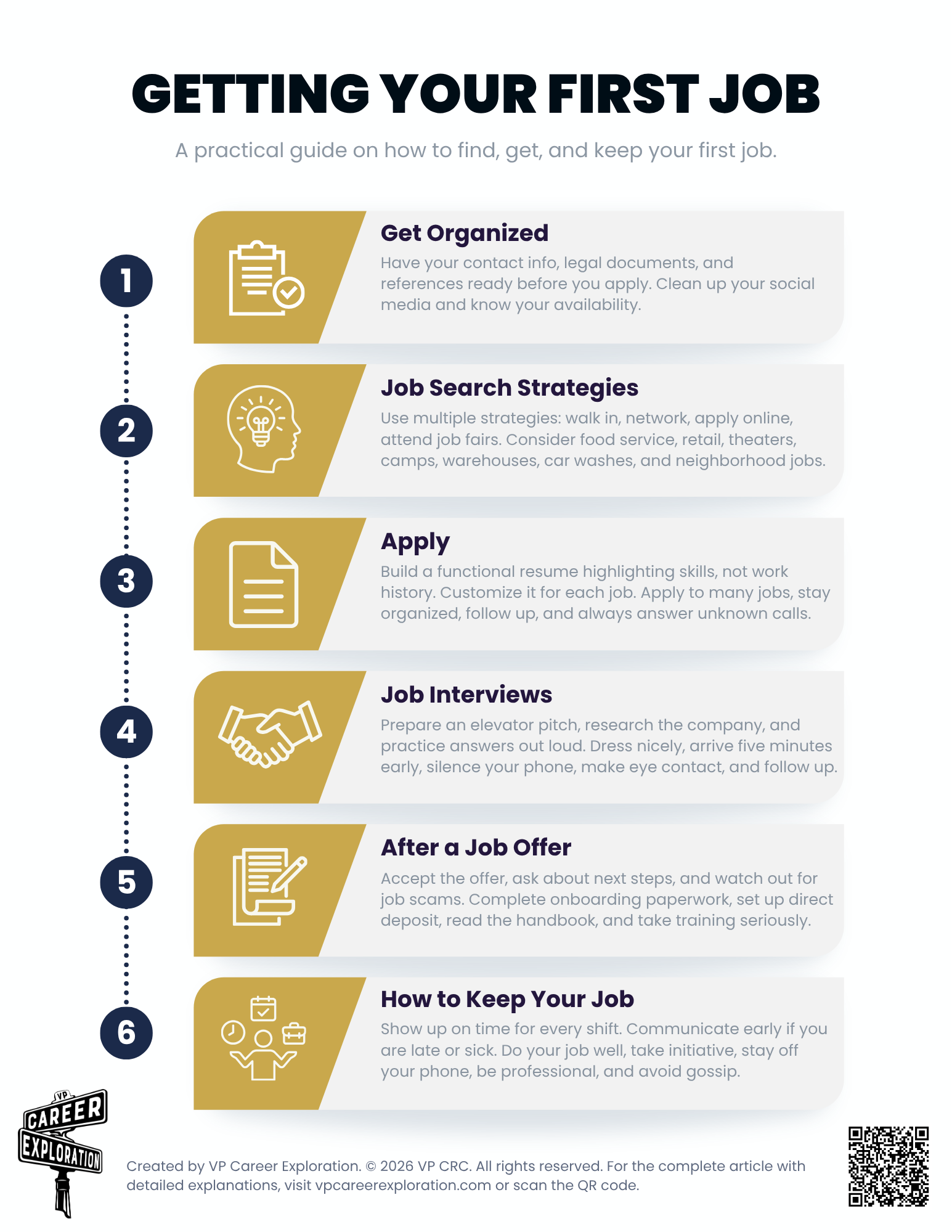
Guide to Get Your First Job