
IS College Really Worth it?
If you have spent any time reading my work you know I have concerns about how young people arrive at college. The underprepared decision making. The skipped career exploration. The student loans attached to majors chosen for the wrong reasons. The study skills gap nobody addressed before move-in day.
All of that is real and worth serious concern and reflection.
Yet, it is not the whole story.
Because college, when it works, offers something that has nothing to do with the degree on the wall. Something that is almost impossible to replicate anywhere else at any other point in life. And in all the debate about ROI and student debt and underemployment rates, that something gets lost.
This article is about those somethings about college that can be easy to overlook.
The transition space nobody names.
For most students, college is the first time they have lived away from home with real autonomy and without the full weight of adult responsibility. That sounds an unimportant experience until you think about what it actually provides.
A structured environment for becoming an adult.
You are responsible for yourself. Your sleep, your meals, your class and work schedule, your choices, and every consequence that follows from them. Nobody is reminding you to do your laundry or asking where you have been. You make decisions and you live with them. Some of those decisions are good. Some are bad. All of them are yours.
At college there is the opportunity to learn to manage your life in an environment forgiving enough to absorb mistakes but demanding enough to require growth. It is one of the most developmentally significant experiences available to a young adult. And most of those lessons happens outside the classroom.
Gallup’s long-running Alumni Survey has found that graduates who say they were challenged academically are more than three times as likely to say their education prepared them well for life outside of college. The skill development is not automatic. It depends on whether students engage with the challenge rather than just move through it. But when it happens, time management, communication, collaboration, independence, those are not just resume words. They are the internal architecture of a functional adult life.
The alternative, moving directly from a structured home environment into a full adult life with full responsibilities, is not impossible. Nor is it destined for failure. Millions of people navigate it successfully. But in my experience working with people across very different paths into adulthood, it tends to be a less forgiving one. Fewer built-in chances to fail safely, recalibrate, and try again before the stakes get higher.
College is, for the students who have access to it and use it well, a supervised practice run for the rest of their life.
Hard things are the point.
College is hard. It is supposed to be.
Not busy hard. Not arbitrary hard. But challenging in the way that requires you to stretch beyond what you already know you can do. A difficult professor. A subject that does not come easily. A group project where you have to figure out how to work with people who think completely differently than you do. A failure, academic or personal, that you have to sit with and learn from without anyone rescuing you from it.
That stretching is where growth happens. And college is one of the best environments available for it. The structure is there. The support is there. The stakes are real but not catastrophic. You can fail a class and recover. You can make a bad decision and learn from it. You can try something and discover it is not for you without it costing you everything.
That does not mean college is the only place this happens. Volunteering and a gap year built around real purpose can produce the same kind of growth. So can military service or a skilled trade pursued with intention. Hard things stretch you wherever you encounter them.
But college puts a remarkable number of hard things in one place, at one time, in an environment designed to support the person doing the stretching.
The people you will know for the rest of your life.
I went to Occidental College. I have friends from those years that I am still close to decades later. That is not nostalgia. It is a specific and documented phenomenon.
A study presented in 2024 by Michigan State University researcher William Chopik tracked the Harvard Class of 1964 for over fifty years and found that having more and closer friends during freshman year of college predicted more positive life reflections, stronger relationships, and less mental illness, at age 72. Fifty years. The people you meet in a dorm hallway at eighteen have a measurable effect on how you evaluate your life at seventy-two.
You are becoming who you are, together, in real time. I have written before about what happens when you do not do the work of defining your own identity. Developmental psychologists call this period of life “emerging adulthood,” and it is widely understood as the primary window for identity exploration before things narrow. That kind of shared formation is rare after college. Most adult friendships form around existing identities. College friendships form around identities still being built.
The professors matter too. The mentor relationship between a student and a faculty member who genuinely cares about their development is one of the most underutilized resources in higher education and one of the most durable. I have written before about the people who change everything, the ones who see something in you before you see it yourself. A professor who sees something in you, names it, challenges it, and holds you to it can change the entire trajectory of what you believe is possible for yourself. I have seen this happen in my own classroom. I have also been on the receiving end of it.
These relationships, the friends and the mentors, do not appear automatically. They require showing up, being present, and taking risks. But the environment of college makes them more possible than almost anywhere else.
The world gets larger.
College exposes most students, often for the first time, to people who grew up differently than they did. Different regions, different backgrounds, different beliefs, different ways of organizing a life. That exposure does something to a person’s thinking that is very difficult to replicate in a more homogeneous environment.
It does not require agreeing with every perspective you encounter. It requires sitting with the complexity of a world that contains more valid ways of living than the one you grew up inside. That is a maturity skill and a career skill and a life skill simultaneously.
Studying abroad amplifies this effect significantly. A 2024 survey from Terra Dotta found that more than 80 percent of students who participated in study abroad programs said the experience changed their worldview, and nearly a third said it profoundly challenged their global assumptions and beliefs. That is not a soft outcome. That is the development of genuine perspective, the ability to see your own assumptions as assumptions rather than as facts. In a world that increasingly rewards people who can navigate across difference, that development is real and measurable value.
Not every student can study abroad. Cost is the primary barrier and it is a real one. But the underlying experience, sustained exposure to people and unique experiences, is available at almost every college campus to the student who seeks it out.
Work, money, and the education nobody planned.
Every college student should work. There, I said it. This may not be a popular opinion with everyone, and I am ok with that.
My opinion is not about the money that so many college students need, though many do need it. The term “poor college student” is very real. But my stance is about something that is more lasting than those meager paychecks. What is learned at a job cannot be replicated in a classroom. Let me explain.
Research dating back decades, replicated as recently as Boston University’s own student employment data, consistently shows that students who work a moderate number of hours, generally up to fifteen per week, have higher GPAs than students who do not work at all. Not lower. Higher. The students develop better time management because they have to. Past fifteen to twenty hours, the benefits reverse: grades decline, stress rises, and the experience narrows. The goal is not exhaustion. It is engagement.
Working teaches what a classroom curriculum does not. How to show up and be reliable. How to navigate working for a supervisor and co-workers. How to tangibly experience the exchange of time for dollars, and then use those dollars to cover daily living expenses.
A late 2025 survey of more than 1,000 U.S. hiring managers found that 62 percent consider hard and soft skills equally valuable, and another 24 percent say soft skills now matter more than technical ones. Employers have noticed the same gap from the other direction. In 2019 nearly three-quarters screened candidates by GPA. Today, according to NACE’s most recent data, only 42 percent still do. Those competencies develop on the job, not in a lecture hall.
Money management is a particular gap. A 2024 WalletHub study found that more than 70 percent of college students feel overwhelmed by their financial responsibilities, nearly 40 percent are more comfortable discussing politics or sex with family than money, and 46 percent feel unprepared for financial independence. Most arrive having never managed money that was genuinely theirs, with consequences that were genuinely real. The first overdraft, the first time the concert tickets and the groceries cannot both happen, that is an education no course delivers.
Which brings me to something I see regularly. Some parents, with the best intentions, delay this entire process. They monitor accounts. They send spending money with no expectation of budgeting. They step in before the consequence arrives.
Research on helicopter parenting is unambiguous. Overinvolvement consistently correlates with decreased resilience, lower self-confidence, and increased anxiety and depression in college students. A 2025 study published in the Journal of Career Development found that helicopter parenting was directly linked to impaired career decision-making, mediated by fear of failure and reduced self-efficacy. Students who were not allowed to fail small did not develop the confidence to decide big.
This is not an argument against financial assistance. Accompany that support with education before they leave, and consequences for their decisions.
To be fair, let us look at the other side.
College can also be four years of expensive drift. Of choosing the path of least resistance through a curriculum that never challenges you. Of surrounding yourself exclusively with people who confirm what you already believe. Of accumulating debt for a credential that was never connected to a career plan. Of graduating no more self-aware than you arrived, having spent four years in an environment designed for growth and used unproductively.
A college experience does not automatically produce any of the benefits described above. A 2024 Handshake survey of the Class of 2025 found that 88 percent of college seniors said college significantly contributed to their personal growth, which is encouraging. But that also means 12 percent did not feel that way.
The outcomes described in this piece can only happen when students are present, intentional, and willing to be uncomfortable. That intentionality does not happen by accident. It happens when young people arrive at college with some degree of self-knowledge, some sense of what they are looking for, and a desire to be prepared for the transition they are about to make.
So, Does College Pass the Test?
Which brings this back, as most things in my writing eventually do, to the work that needs to happen before the first day of class.
College is a remarkable environment for growth. The degree is one outcome of the experience. But it is not the only one, and for many students it is not even the most important one. The relationships, the perspective, the self-knowledge, the practical competencies of managing your own life, those are the outcomes that compound across a lifetime.
Those are the benefits. Real, documented, and available to anyone who attends college.
But part of achieving these outcomes depends upon you. None of it happens automatically. The relationships, the perspective, the self-knowledge, none of that shows up just because you enrolled. You have to look for and work for it.
There are a lot of benefits to attending college. But whether college passes the test is ultimately up to you to decide.
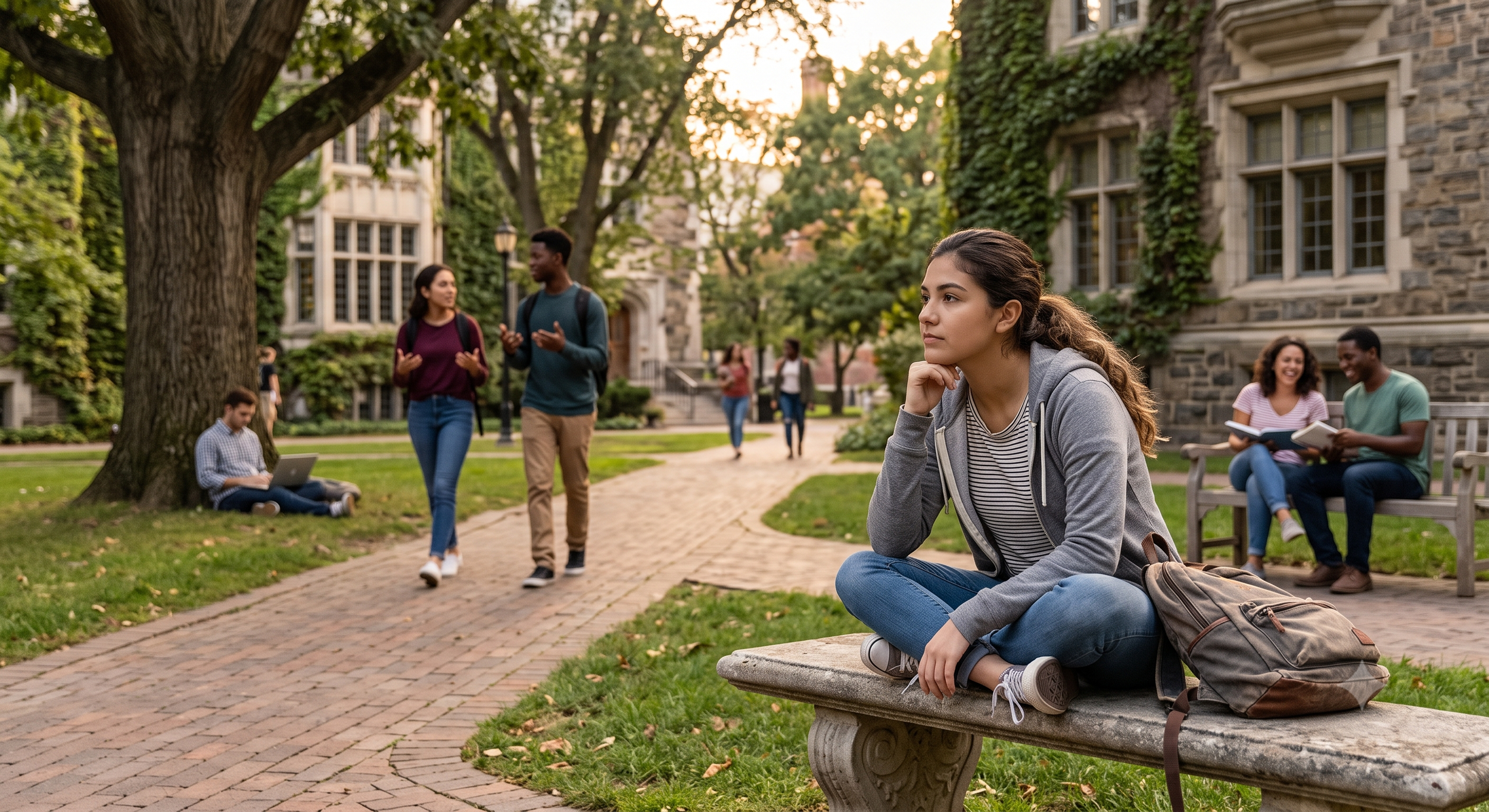
Is college is worth it? It could be, for more than just the degree.
FAQ
Is college worth it beyond the degree? For many students, yes. College offers a structured, forgiving place to practice becoming an adult, build lifelong friendships and mentor relationships, and see the world through new perspectives. The degree is one outcome, but for many students it is not even the most important benefit. But to be fair, each student is different. For some, college is not the best choice. It really is up to each individual to decide.
Should college students have a job? I believe every college student should work. Research shows students who work a moderate number of hours, generally up to fifteen per week, tend to have higher GPAs than students who do not work at all. A job teaches reliability, how to work with a supervisor and co-workers, and how to manage real money.
How can students get the most out of college? None of the benefits of college happen automatically. Students need to be present, intentional, and willing to be uncomfortable. That starts before the first day of class, with some self-knowledge and a sense of what they are looking for.