
Hard in School Does Not Mean Hard for Life. Or Work.
When I tell people I have dyslexia, the response is almost always the same.
“Oh, so you write things backwards?”
No. Never. Not once in my life.
I should say something honest before I go further. I have never received a formal dyslexia diagnosis. My sister was flagged by her kindergarten teacher and diagnosed. Turns out my dad received reading support at Stanford in the late 1950s. And it is well established that dyslexia commonly runs in families. The pattern in my family makes it difficult to call what I am anything else.
I am not an unusual story. In the 1980s, dyslexia was significantly underdiagnosed across the board. And especially in girls, who tended to compensate quietly, cause no trouble, and fly completely under the radar. Nobody was looking for me. And I was very good at hiding.
Even today, there are misconceptions surrounding dyslexia, just like the assumption that it means you must write things backwards. Because like most learning disabilities, dyslexia does not look the same in any two people.
The chart below shows just some of the ways dyslexia can show up, across reading, writing, spelling, memory, neurodevelopment, auditory processing, and vision. I have almost every single one of those. Except reversing letters. This illustration is by no means all inclusive of the full range of characteristics a person with dyslexia may experience.
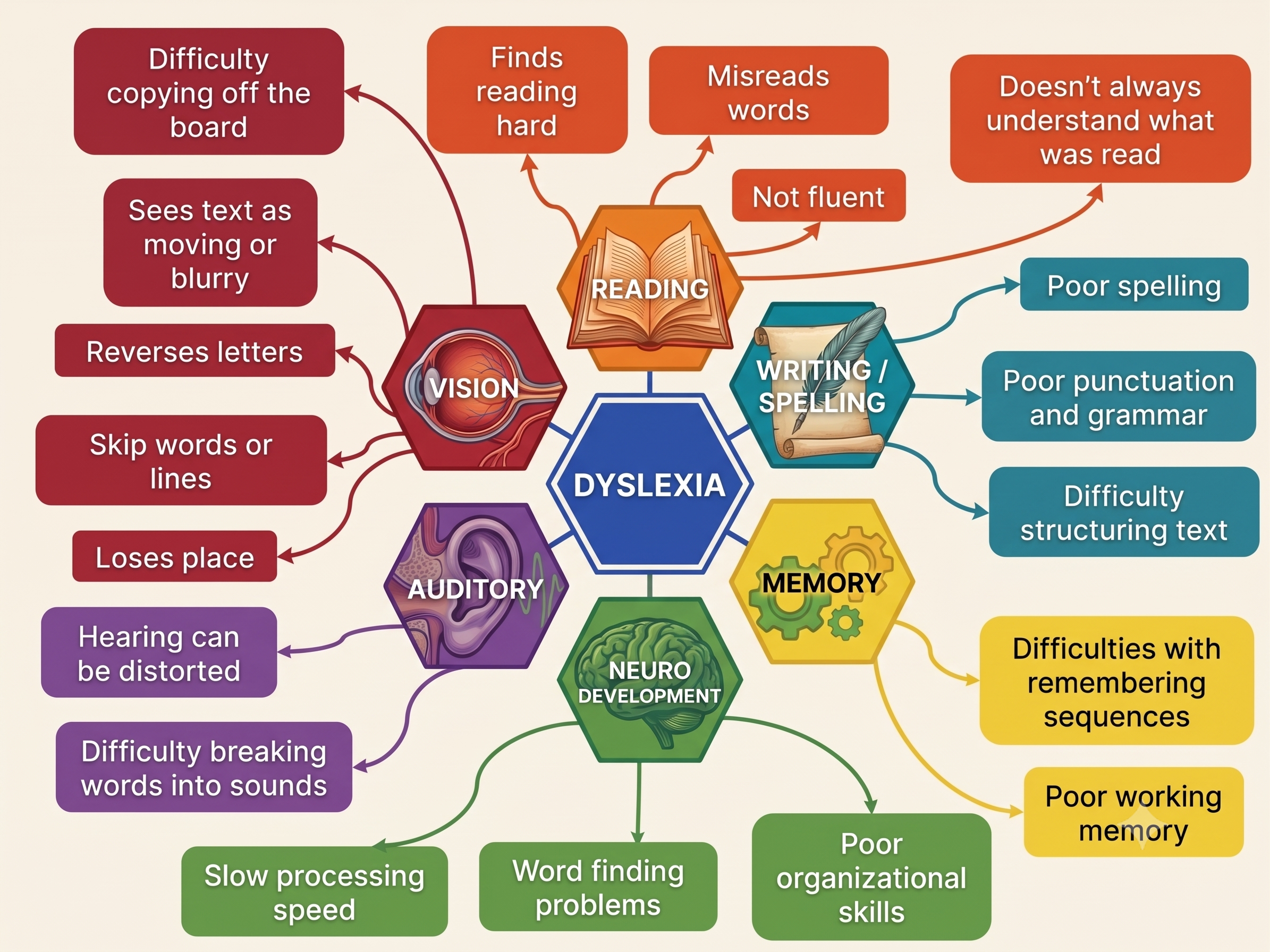
Dyslexia is not one thing. It does not look the same in any two people. This is just some of what it can look like. I have almost every one of these. Except reversing letters.
Here is what I do know, speaking just for myself and my personal experiences. For most of my childhood, I had no idea any of this had a name. I just called it stupid.
Ironically, this stupid kid was really good at hiding the fact that she was stupid at school. But my deep dark fear was that one day I would not be able to hide it anymore when I became an adult. How can you hide stupid at work?
What hiding looked like.
I remember watching a Cosby Show episode where one of Dr. Huxtable’s patients had a father who could not read. He had hidden this secret in shame his entire life.
That was my secret too. Except I could read. Kind of. Just enough to get by and hide in plain sight.
I watched that episode with dread and horror, seeing what my future held in store for me. And I wondered how he was able to hide that he could not read and still hold a job. I knew my entire life would be a continuation of what school was. Hiding my stupid.
In second grade, an adult pulled me aside while my class was in the library. She asked me to read her a book. It was Hop on Pop.
Hop on Pop. A book most kids master in kindergarten. Or before. I was in second grade and I struggled reading it to her. The pictures and the redundancy helped and I eventually got through it. I was so embarrassed. I was sure my stupid secret was out.
Apparently I did well enough. Nobody followed up. Life went on.
How did my teachers and parents not know? Well, to be candid, they should have. But also, to my credit, I was really good at hiding.
I remember the first book I ever read was in fifth grade. But it was not a book. It was an 88-page pamphlet they handed out to the girls in class about puberty. I read it alone in my room after school over several days, in secret.
Part of me wanted to feel proud. I read almost 100 pages. Something I had never done before. Something my classmates did regularly without effort or ceremony. But I could not let myself celebrate, because I knew it should not have been that hard. And yet for me it was enormous. I just could not tell anyone, because then they would know about my stupid secret. (As well as the desperation I had wanting to understand what was in store for me when it came to puberty!)
I developed a rather strategic system to conceal my stupid as I moved into middle school and high school. Do all your homework. Be likeable. Never cause problems with teachers. I figured out that if you always do your homework and fail every test, you can still squeak by in most classes with a low B as long as the teacher is on your side. Sometimes I got C’s. But with A’s in math and PE, my overall GPA did not alarm anyone at home or at school.
My older sister, meanwhile, always got straight A’s. Which earned her a celebratory dinner out for Chinese food. I loved those dinners. My parents never made me feel less than for joining along to celebrate her. I just congratulated my sister and enjoyed the cherry pork and moo shu chicken and said nothing about my grades.
I had been quite successful at hiding my stupid through most of high school until my youngest sister outed me. As I mentioned, when she started kindergarten she was diagnosed with dyslexia and the adults around me started putting the pieces together about how that diagnosis might make sense for me too.
My sister got real help at school, with tools and support. And interestingly, she reports that she still struggled in school. Because help does not remove dyslexia. It manages it. Accommodations are wonderful, but they do not make disabilities go away. But what her school experience gave her that I did not have was the knowledge that she was not stupid. She was dyslexic.
That there was a different name for it. A more accurate one.
The gap between her experience and mine was not about intelligence or effort. It was about timing and knowledge. In the early 1980s, what was known about dyslexia, how it presents, how it varies from person to person, was a fraction of what exists today. In October 2025, the International Dyslexia Association released its first revised definition of dyslexia since 2002, reflecting decades of new scientific evidence and the lived experiences of people with dyslexia. Among the most important updates: children of all cognitive profiles, including kids with strong math scores, can have dyslexia. That last part matters. Because that was me.
What we know now.
If you want to see dyslexia education in action, I am intrigued by the work of Dr. Jacob Santhouse. He is a Licensed Clinical Professional Counselor, dyslexia coach, and a dyslexic himself, and a current and accessible voice helping people actually understand dyslexia. His online content is engaging, grounded in both research and lived experience, and he has a new book, Dyslexia Explained: Your Toolkit to Understanding and Thriving, publishing this October.
Another source I value is Drs. Brock and Fernette Eide, authors of The Dyslexic Advantage. They argue that the challenges of dyslexia are not the main features of the condition. They are trade-offs, resulting from a pattern of brain organization that also comes with powerful strengths in areas like spatial reasoning, narrative thinking, and big picture problem solving. The same dyslexic brain that makes reading hard also makes building something easy. According to their research, approximately 20 percent of the population has dyslexia, and dyslexic adults routinely outperform their non-dyslexic peers in studies on three-dimensional spatial reasoning and divergent creativity.
The Cosby Show episode I mentioned earlier tried to end on a note of hope for the man who could not read. I was skeptical of that optimism even as a child. I saw it as television fantasy, a tidy resolution at the end of a 24-minute story that offered nothing reflective for my future. But it tried. In the best way the 1980s knew how, to offer hope to people who struggled to read.
Today, in 2026, what we know about dyslexia, its many nuances, and the remarkable strengths and struggles that come alongside the dyslexic brain is extraordinary compared to what existed during my childhood. And more research and understanding is emerging all the time on how to help dyslexic minds thrive. It is exciting to watch. Dare I say, more exciting than a new Cosby episode was to a kid in the 80s.
What grades do not measure.
As a professor at a community college, I see it every semester. Students arriving carrying the weight of what school, and their family, and the world, has told them about themselves. That they were not smart enough. That they were behind and would never catch up. That they had already proven what they were capable of, and it was not much. They seem convinced that if school was hard before, college will be too hard now.
I want to say something directly to those students. Before you give up and walk away.
First, college will be hard. It is supposed to be hard. For everyone. That part is true and I will not pretend otherwise.
Second, hard in school does not mean hard at work. I know this personally.
I watched that Cosby Show episode as a child and wondered how I would ever survive in the working world when I could barely survive school. That fear was real. And then I went to work. And something unexpected happened.
I was good at work.
Not despite my stupid. I think, in a lot of ways, because of it. The same brain that could not sit still long enough to absorb a textbook was wired for problem solving, people reading, creative thinking, and figuring things out on the fly. Work rewards things school do not grade.
What I spent years calling stupid turned out to be dyslexia. My disadvantage. My hard. My struggle. My obstacle. My challenge. And also, it turned out, it gave me an edge.
And I was not alone in that. A lot of people with dyslexia share the same thing. School was the hard part. Work was where they found their footing.
It does not matter whether that hard comes from a learning disability, an attention difference, an emotional struggle, a chaotic home life, a language barrier, or simply a brain that did not fit neatly into the way school was designed to teach. Hard is hard. Hard in school does not mean higher education is not meant for you. And it most definitely does not mean you will not be successful at work.
Grades are not measuring your future ability to work hard and succeed. They measure a very specific and narrow set of skills in one particular way, at one particular pace, on one particular timeline.
Research published in the Journal of Applied Psychology found that since the 1920s, academic performance has weakened as a predictor of job performance, and that GPA has lost significant predictive validity when it comes to how people actually perform at work. The workplace rewards a completely different skill set. Relationship building. Problem solving. Resilience. Creativity. Adaptability. The ability to figure things out under pressure. Nobody gets graded on those things in school. But they are what careers are actually built on.
And the students who had to fight hardest to get through school? Who learned to advocate for themselves, work twice as hard, and navigate systems that were not built for them? They often arrive in the workforce already knowing how to do the hard thing. Not in spite of the struggle. Because of it. Those skills, on top of the education and expertise of their field, are a pretty remarkable predictor of future success, far more than a GPA or standardized test score.
To be clear, I do not want to romanticize learning disabilities or hard circumstances. They are hard. And career exploration with a learning difference can have its own set of barriers and limitations.
Also to be clear, learning differences that make school hard do not mean all jobs and careers will be hard. Some of the most capable, determined, creative professionals have dyslexia, ADHD, processing disorders, anxiety, and other learning and attention differences. Not despite those things. Sometimes it is because of them.
I am not going to tell you college will be easy. It will not be. It is not supposed to be, for anyone.
Every class I took was hard. Every test was hard. Every paper was hard. But I learned from it. I grew from it. I persevered. And I am who I am today, as a person and as a professional, because of it. I have the life I have because what I spent years calling stupid was actually teaching me to be resourceful, to work hard, and to never give up, even when I was giving it the wrong name.
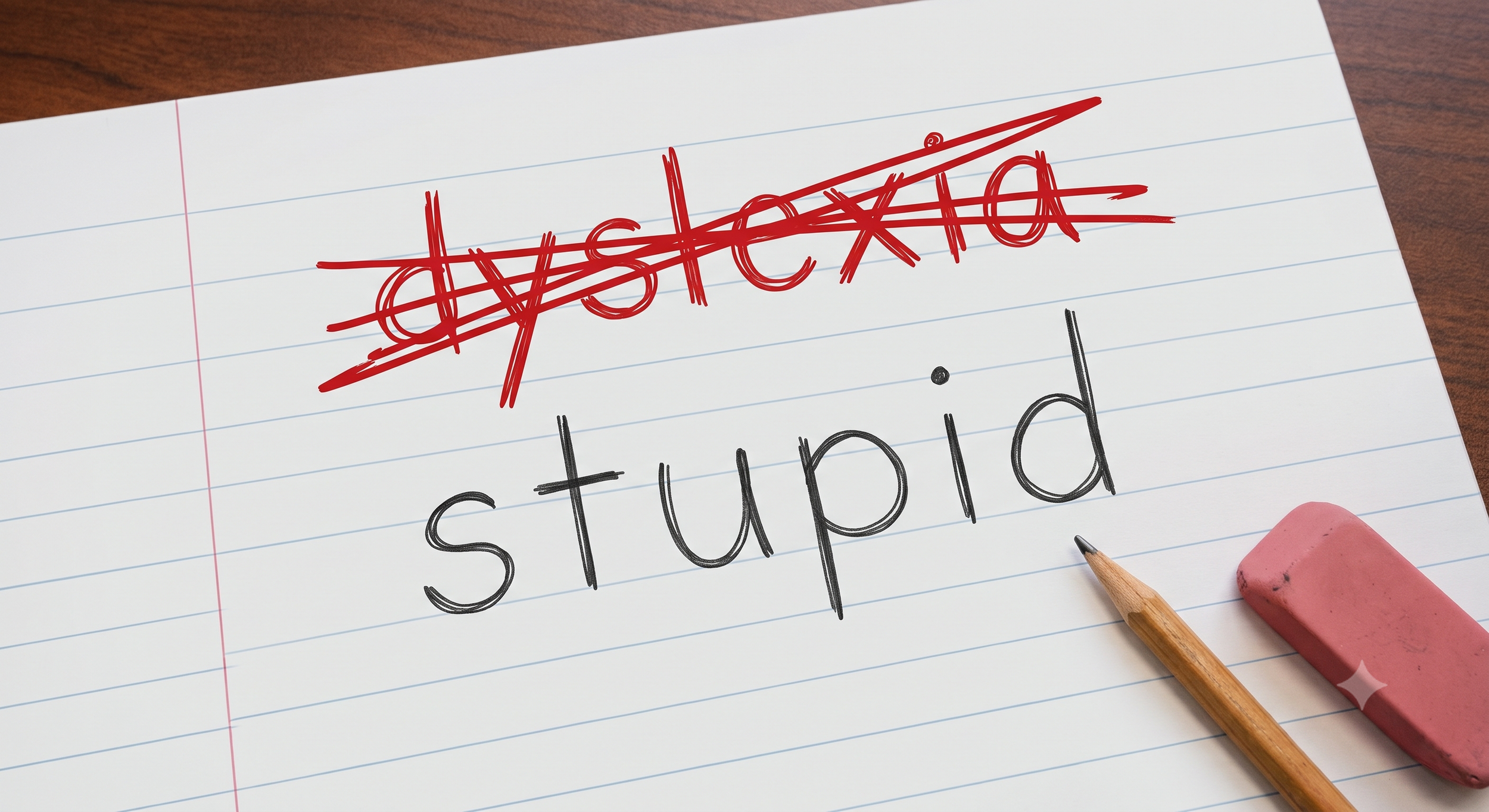
What I called it before I knew what it was.