
Job. Career. Do You Know Which One You Have?
Every semester, early in my Career and Life Planning course, I ask my students a question.
Do you, or have you, had a job?
Most hands go up. Almost everyone has worked at some point. Fast food, retail, babysitting, landscaping, something.
Then I ask some follow-up questions.
Is that job your career? And, would you want that job to be your career?
Rarely does a hand stay up.
That is exactly where I want them to start our discussion on job versus career. Most people have never actually had to define the difference. They know their first job is not their career, even if they have never thought or talked about it before. So we spend the rest of class trying to figure out what separates one from the other.
First, the joke.
We laugh about the word job in class. J.O.B. Just Over Broke.
It is a joke. But it lands every time because it captures something true about the relationship between a job and financial survival. A job keeps you afloat. It pays the bills. It puts gas in the car and food on the table. And whether it is a job or a career, most of us are there for the paycheck. Let us not pretend otherwise.
That is not cynical. That is honest. Work is an economic transaction as much as anything else. The question is whether it is only that.
So what is the difference?
A job is something you get because you need something, usually income. You apply, you get hired, you show up, you get paid. It does not require much thought about who you are or where you are going. It requires being available and having skills that match what someone needs done right now.
A career is something more intentional. It involves training, education, a sequence of choices that build toward something. It has direction. It reflects, at least in some way, who you are and what you are working toward professionally.
But here is what I tell my students every semester. There is often no clear, definitive line between the two. It is not like there is a moment where a switch flips and suddenly you have a career instead of a job. The distinction is messier than that, and more personal. Which is exactly what makes it worth examining.
Then I ask about their parents.
Does your parent, or parents, have a job? Is that job just a job, or is it their career?
Students have to actually think about it. And what they come back with is almost always more nuanced than they expected. Some say career, clearly and confidently. Their parent went to school for it, trained for it, has been doing it for years, talks about it at home, cares about it beyond the paycheck. Some say job, no hesitation. Their parent shows up, does the work, comes home. The work is just the work. The do it for the paycheck.
Occasionally there is another response. Uncertainty. They are not sure how their parent would define their work. They have never had that discussion with them. I encourage them to ask.
That uncertainty, it turns out, is not just a college classroom phenomenon. It shows up in the national data too.
According to a 2024 Pew Research Center survey, half of American workers consider their current job a career. Fifteen percent say it is a stepping stone to a career. And thirty-five percent say it is just a job to get them by. Which means roughly a third of the working population is doing something that does not feel like a career to them at all. And many of the people who do call it a career probably did not plan it that way from the beginning.
The student who said the thing I keep thinking about.
One of my students last semester had worked in the same industry for several years, longer than most of her classmates had held any position at all.
She said she knew it was no longer just a job when she found herself thinking about work outside of work. Spending time and energy on it voluntarily. Turning problems over in her mind on her own time. Reading about it. And not minding.
I loved that observation. Because it captures something about the job to career shift that no definition quite manages to. It is not just about the credential or the plan or the training. It is about investment. It is about whether the work has become interesting enough to follow you home. Whether you are in it beyond the transaction.
A job can become a career without it having been the plan. Just like a carefully planned career can start to feel like just a job. Both happen. On purpose. And by accident.
Why this matters more than it sounds.
If you are looking for a job, the questions are: What is available? What do I qualify for? Reasonable questions. Sometimes exactly the right questions. When the rent is due and the bills are real, job questions are the appropriate ones.
But if you are building a career, the questions are different. What do I actually want to do with my professional life? What kind of work fits who I am? What am I willing to train for and commit to over time? Those questions require a level of self-knowledge that a job search does not demand and that most people have never been helped to develop.
That is the gap. Not between jobs and careers exactly. Between people who have thought about it and people who have not. Between showing up and deciding.
Here is why the distinction is worth sitting with, rather than shrugging off.
The Conference Board’s 2025 survey found that job satisfaction reached its highest level since the survey began in 1987, driven largely by meaningful work, manageable workloads, and a sense of direction, factors that mattered more to overall satisfaction than pay itself. The same research found that workers who switched jobs reported higher satisfaction than those who simply stayed put without a clear sense of why. Staying is not the problem. Staying without direction is.
And that is an important distinction. Because career is not just a nicer way of saying job. It comes with more satisfaction, more sense of purpose, and a clearer path to keep building, even when the paycheck looks similar on paper.
So let me ask you the same questions I want my Career and Life Planning students to wrestle with.
Do you want a job? Do you want a career? And how can you make sure you get what you want?
Those questions are worth sitting with and discussing with someone you trust. These really are conversations worth having. Sooner, rather than later.
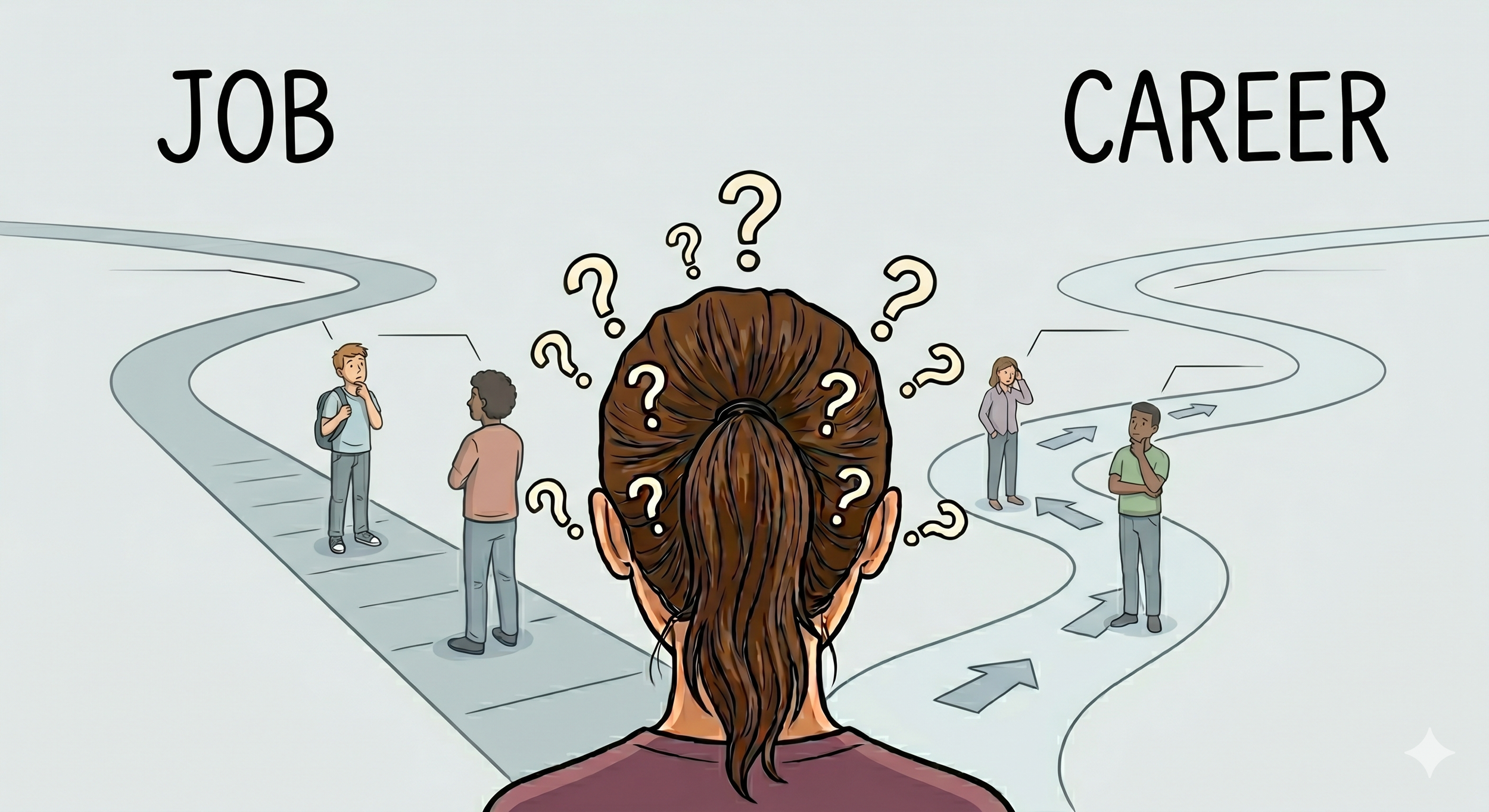
Almost everyone has had a job, but is it your career? Here is how I help my students think through job vs career, and why the difference matters more than it sounds.
FAQ
What is the difference between a job and a career? A job is something you get because you need something, usually income. A career is more intentional. It involves training, education, and a sequence of choices that build toward something and reflect who you are. There is often no clear line between the two, and that is what makes it worth examining.
Can a job turn into a career? Yes. A job can become a career without it ever having been the plan. One sign is when you find yourself thinking about work outside of work, turning problems over on your own time, and not minding. Just like a carefully planned career can start to feel like just a job.
How do I know if I want a job or a career? Job questions ask what is available and what you qualify for, and sometimes those are exactly the right questions. Career questions ask what you actually want to do, what kind of work fits who you are, and what you are willing to train for over time. These are questions worth discussing with someone you trust, sooner rather than later.