
Nobody Taught Us How to Choose a Career. I Learned the Hard Way.
A psychology professor once told my class something I have never forgotten.
“Ask anyone with a PhD in psychology what their dissertation was on,” he said, “and you will know what was wrong with their childhood.”
The class laughed. I laughed. And then I spent the next twenty years slowly realizing he was talking about me.
I don’t have a PhD. I have a master’s degree in Vocational Rehabilitation. But my professional life — what I teach, what I counsel, the book I wrote, the business I built — is one long attempt to give other people something I never had.
A roadmap.
Here is what nobody tells you about career decisions.
Most people don’t think about them until something goes wrong. They’re miserable at work. They got laid off. They’re halfway through a degree they hate. They’re forty and wondering how they got there.
But by the time crisis hits, real career exploration becomes nearly impossible. When you’re in survival mode — when you need a paycheck, when the rent is due, when the couch you’re sleeping on belongs to someone else — you don’t have the luxury of asking what fits your strengths or aligns with your values. You take what’s available. And then you spend the next decade being quietly good at something that is slowly making you miserable.
We tell people to eat well before they get diabetes. We tell them to exercise before the heart attack. We tell them to see the dentist before the root canal.
But career exploration? We treat it like a fire extinguisher. Only useful when something is already on fire.
The result is staggering. According to the Federal Reserve Bank of New York, more than 40 percent of recent college graduates are working in jobs that don’t require the degree they just paid for. Billions of dollars in student loan debt attached to degrees that don’t lead anywhere meaningful. Adults years into careers that don’t fit them, with no idea how to change course. Teenagers making six-figure financial decisions based on what their best friend is doing or what they Googled at midnight before an application was due.
This is not a personal failure. It is a gap in the system.
My story is not unique. That’s exactly the problem.
I went to one of the top public high schools in California. My graduating class had nearly 20 National Merit finalists. Going to Stanford or an Ivy League school wasn’t remarkable — it was the norm. I knew no different.
I was also dyslexic, though nobody figured that out until my junior year of high school. By then I had spent years quietly convinced I was just not as smart as everyone around me. That is what it feels like when you are struggling and no one has an explanation for why.
When it came time to choose a college, I had exactly two criteria. I had to play softball. Prestige was a bonus. But mostly, softball.
That was my entire decision-making process. No thought about whether I was academically prepared. No thought about majors or careers or what I actually wanted from the experience. Softball was the one place where I knew I was good at something. It was what fed my starving self-esteem.
In retrospect, community college was exactly where I should have gone. I could have gotten my academic footing, figured out what I actually wanted to study, saved significant money, and still played softball. But that thought never had a chance to form, because my world made it socially unthinkable before I ever thought it.
So I chose Occidental College. Struggled through. Graduated with a Bachelor of Arts in Cognitive Science with an emphasis in Psychology.
Go ahead. Google “jobs for Cognitive Science majors.” I’ll wait.
crickets
Here’s where it gets relevant to you.
With tens of thousands of dollars in student loans that need to be paid, I needed a job. Any job. A connection through a friend of a friend got me an interview at BNSF Railway. The salary was also enough to get off my sister’s couch! So I became a Claims Representative.
And I stayed for almost ten years.
I was good enough at it. Not great, but good. It met my salary needs. It met my security needs.
But here is what it did not meet: my values, my strengths, my interests, or the future I actually wanted.
Unfulfilled is the right word. That quiet, nagging kind of unfulfilled that doesn’t announce itself dramatically — it just gets louder and harder to ignore until you can’t sleep through it anymore.
At no point did anyone ever ask me the right questions.
Not in high school. Not at Occidental. Not from a single professor or advisor.
What are you good at? What genuinely interests you? What do you value? What do you want your life to actually look like?
Nobody walked me through a process for figuring out who I was before deciding what to become. Nobody helped me connect my strengths, my interests, my values, and my goals to a path that actually fit. Nobody talked to me about the financial realities of different educational investments. Nobody helped me see that the peer culture I was swimming in was quietly shaping every decision I made.
I made every major educational and career decision of my early life based on fear, peer pressure, external expectations, sheer necessity, and softball.
And I am not unique. Not even close.
Career exploration shouldn’t wait for a crisis.
It should happen long before one — when you actually have the time, the space, and the freedom to choose well.
That’s why I became a Licensed Vocational Rehabilitation Counselor. That’s why I teach career exploration at a community college. And it’s why I wrote Career Compass: A Guide to Career Exploration — a book designed to walk anyone through a structured process for figuring out who they are before deciding what to become. Not what pays well, not what their parents want, not what their best friend is doing. Who they actually are — their strengths, their values, their interests, their goals — and how to use that self-knowledge to make a decision that actually fits.
I didn’t write a dissertation. I wrote a book instead. But the subject matter is still the thing I most needed and never had.
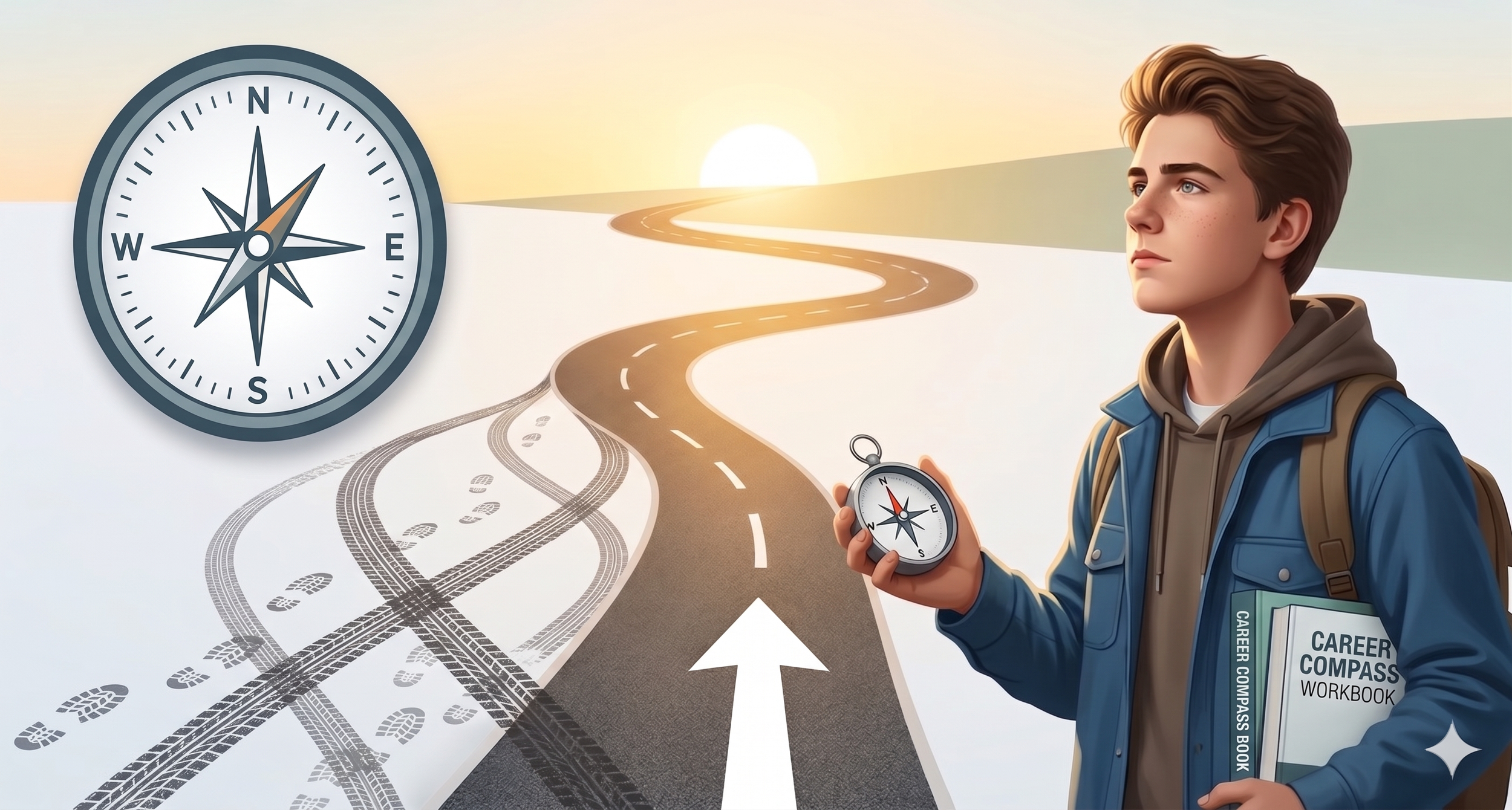
Career exploration roadmap to help find direction in career exploration.
Next Steps for Your Career Exploration
Get a Guide: Get your copy of Career Compass: A Guide to Career Exploration to build your personal career roadmap step by step.
Take a Career Assessment: Uncover clear, actionable insights about your unique personality preferences and career interests to point you in the right direction. Complete a career assessment and schedule a 1-on-1 career guidance session.