
The Person Who Changed Everything: Why Every Career Needs a Mentor
Think about the adults who shaped you professionally.
Not your parents, though they count too. The other ones. The coach who saw something in you before you saw it in yourself. The teacher who assigned you a project that changed how you thought. The boss at your first real job who taught you how to show up. The family friend who sat down with you at Thanksgiving and asked what you actually wanted to do with your life and then actually listened to the answer.
If you have someone like that in your memory, you already know what mentorship feels like from the inside. You probably did not call it mentorship at the time. You called it a relationship. But that is what it was.
And if you are sitting here trying to think of someone and coming up empty, you know something about that absence too. You navigated the transition from school to work, from who you were to who you were becoming, without a guide. And while you may have gotten where you are, the path was harder than it needed to be.
The numbers behind the feeling.
Mentorship is one of the most studied and most consistently supported interventions in career development research. The data is not subtle.
The gap between believing mentorship matters and actually having a mentor is one of the most consistent findings in this research. Almost everyone recognizes the value. Roughly half are receiving it.
And the half that is not receiving it is not evenly distributed.
The gap is not evenly distributed.
The mentorship deficit does not fall equally across all populations. And it is worth naming honestly.
Research from RAND published in 2025 found that one in three boys and young men does not have an adult male he can turn to for guidance on his future. First generation college students are significantly less likely to have professional mentors than their peers whose parents navigated the same systems. Foster youth aging out of care enter adulthood without the family network that most young people draw on for informal career guidance. Women in male dominated industries often find themselves without mentors who have navigated the same path. People from lower income backgrounds have smaller professional networks and less access to the kind of informal mentorship that more advantaged peers absorb simply by existing in environments where it is available.
The pattern is consistent across all of these populations. The people who most need mentorship are the least likely to have it. Not because they are less deserving of it. Because the systems that distribute mentorship, formal programs, professional networks, family connections, informal relationships built through proximity to professional environments, are not equally accessible to everyone.
That is not a reason to give up on mentorship. It is a reason to be intentional about it. Both in seeking it out for yourself and in offering it to the people in your orbit who may not know to ask.
What mentorship actually is.
Here is what I tell my students, and it is not what most people expect to hear.
A mentor is not a formal program. It is not a once a semester coffee meeting with a career center assigned contact. It is not a LinkedIn connection who agreed to a thirty minute informational call.
A mentor is a person who takes a genuine interest in your development. Who knows you well enough to tell you the truth. Who has walked a path you want to walk, or a path adjacent to it, and who is willing to share what they learned. Who checks in not because it is scheduled but because they actually want to know how you are doing.
That relationship can exist in a formal program or it can exist entirely outside of one. It can be your uncle who has been in the same industry for twenty years. Your high school coach who still texts you when something big happens. Your favorite professor who wrote you a recommendation and has stayed in your corner since. Your first real boss who saw potential in you before your resume warranted it. A trusted person from your faith community who has navigated a career transition you are facing. A colleague a decade ahead of you who remembers exactly what this stage felt like.
The title does not matter. The relationship does.
You need more than one. And you need them at different stages.
This is the part that does not get said often enough.
Mentorship is not a one-time acquisition. You do not find a mentor at twenty-two and coast on that relationship for the next forty years. The mentor who was most valuable to you at the beginning of your career may not be the person best positioned to help you navigate a career change at forty. The coach who shaped you as an athlete may not know anything about the professional field you are entering. The professor who championed your academic work may have no insight into the industry you are joining.
Different stages of a career require different guides. Different questions require different wisdom. And the network of mentors you build across a lifetime, drawing on different people for different things at different times, is one of the most durable professional assets you can develop.
Practically this means staying open to mentorship across every environment you move through. Your workplace. Your faith community. Your professional associations. Your alumni network. Your neighborhood. Mentors are not rare. They are everywhere. They are usually willing. And most of them are waiting to be asked.
The ask that most people never make.
Here is the honest obstacle.
Most people who do not have mentors do not have them because they never asked. Not because there was no one available. Not because the people around them were unwilling. Because asking felt presumptuous, or awkward, or too vulnerable, or like admitting you do not have it figured out.
You do not have it figured out. Nobody does at the beginning. That is precisely why the ask is appropriate.
Research on mentorship consistently shows that most experienced professionals are genuinely willing to mentor when asked directly and respectfully. They remember what it was like to be where you are. They often wish someone had done for them what they are now being asked to do for you. The barrier is almost never the mentor’s unwillingness. It is the mentee’s reluctance to ask.
Ask anyway. The worst answer is no. And no is considerably less expensive than navigating the next ten years without guidance.
And then become one.
The piece would not be complete without this.
Mentorship is not just something you receive. It is something you eventually give. And the giving is not separate from your own professional development. It is part of it.
Research shows mentors themselves had a 69 percent retention rate at their organizations, significantly higher than non-participants. The act of mentoring someone else clarifies your own thinking. It forces you to articulate what you know and how you know it. It connects you to someone at an earlier stage of a journey you have already traveled, which has a way of reminding you why the journey mattered.
The family friend who sat down with you at Thanksgiving and asked the right questions probably did not think of themselves as a mentor. They were just a person who cared enough to be present and curious and honest with a young person who needed it.
You are that person for someone right now. Whether you know it or not.
Show up for them the way someone showed up for you. Or the way you wish someone had.
That is how the gap gets closed. Not by a program or a policy or a mandate. By people deciding to be present for each other across the distance of experience.
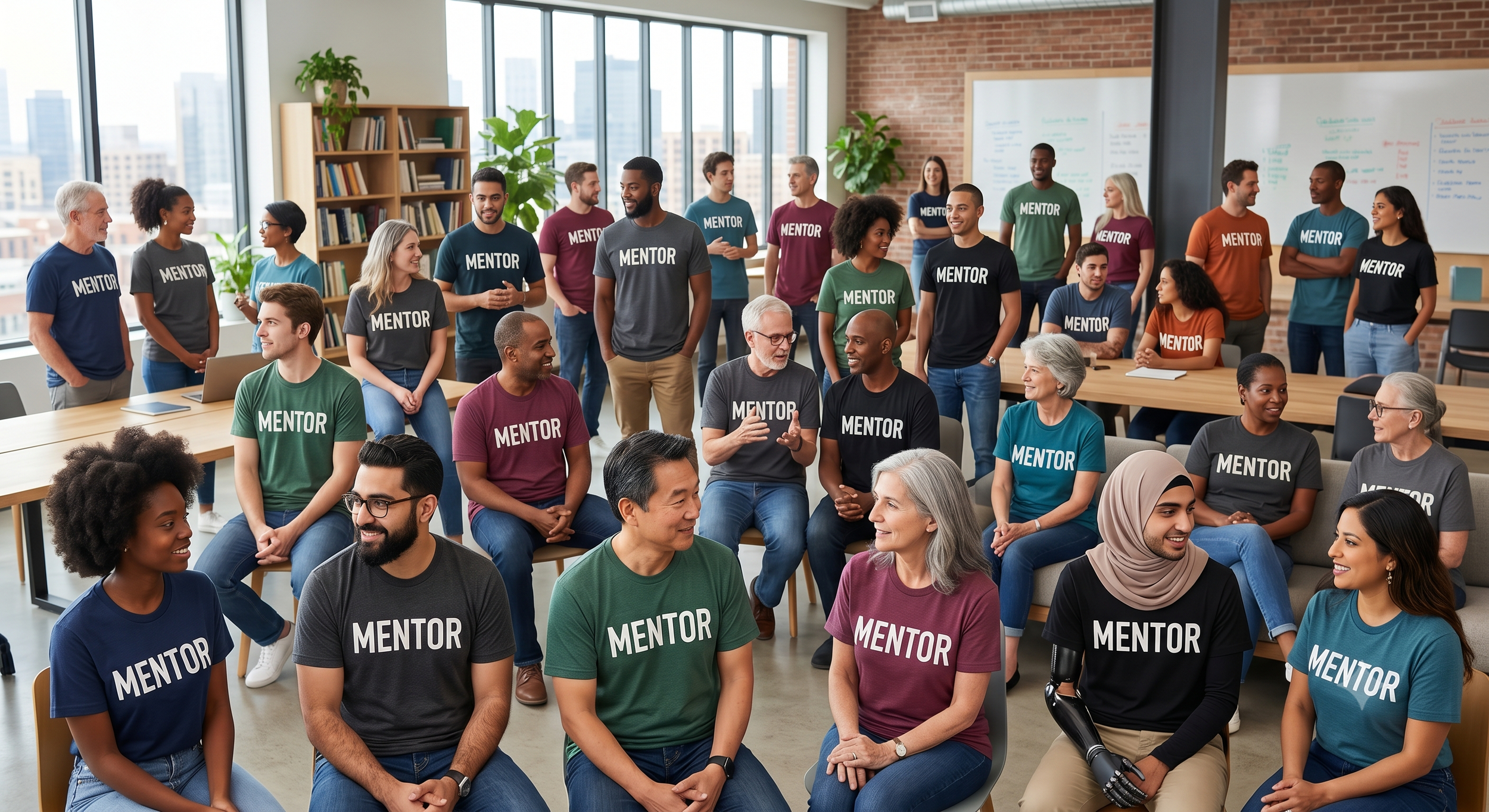
Why Every Career Needs a Mentor
FAQ
What is a career mentor? A career mentor is a person who takes a interest in your development, knows you well enough to tell you the truth, and has walked a path you want to walk. It doesn't have to be a formal program. It can be an relative, a coach, a professor, or your boss. The title does not matter. The relationship does.
How do I find a mentor? Most people who don't have mentors simply never asked. Experienced professionals are usually willing to mentor when you ask directly and respectfully, because they remember what it was like to be where you are. Look in your workplace, faith community, professional associations, alumni network, and neighborhood, and then make the ask.
Do I need more than one mentor? Yes, most likely. The mentor who helped you at the start of your career may not be the right guide for a career change at forty. Different stages and different questions call for different people, and building a network of mentors over a lifetime is one of the most durable professional assets you can develop.