
We Teach Kids Everything Except How to Choose a Career. That Is the Real Crisis.
Every year, millions of students graduate from high school and head straight into one of the most consequential decisions of their lives with almost no preparation for making it.
For some, the next stop is a college campus. For others, it is the workforce. For a growing number, it is a trade program, a certification, an apprenticeship, or something they are still trying to figure out.
The path varies. The problem does not.
Regardless of where they are headed, almost none of them have been given the tools to make that decision well. High school is focused on getting students to graduation. College is focused on getting students through a degree. Workforce training programs are focused on getting workers into jobs. And somewhere in all of that forward momentum, the most important question never gets asked.
Who are you? And what kind of work actually fits you?
Career exploration gets skipped. Not because it is unimportant. Because it is uncomfortable, it takes time, and there is always something more urgent pressing in. A deadline. A scholarship application. A parent who just wants a plan. A bill that needs to be paid. And so people pick what seems safe, or what their parents suggest, or what their friends are doing, or what sounds impressive, or simply what is available. They move forward. And sometimes it works out. And sometimes, a lot of the time, it does not.
The evidence is not hard to find. According to the Federal Reserve Bank of New York, more than 40 percent of recent college graduates are working in jobs that do not require the degree they paid for. And the searching begins long before graduation. A 2024 study by the American Academy of Arts and Sciences found that nearly half of all college students, 47 percent, changed their primary major at least once before completing their degree. Each change adds time, money, and in many cases additional debt to a path that was already expensive to begin with.
The pattern does not stop there. According to the Bureau of Labor Statistics, the average person holds nearly 13 jobs between the ages of 18 and 58, and more than 40 percent of those jobs are held before age 25, when people are still trying to figure out where they actually belong.
These numbers span every educational path. College graduates. Trade workers. People who went straight into the workforce at eighteen. The misalignment is not a college problem or a trades problem or a workforce problem. It is a career exploration problem. And it affects nearly everyone who was never helped to ask the right questions before making the decisions that shaped their path.
This is not a personal failure. It is a gap in the system.
I see it in my Career and Life Planning course at the community college level. I see it in the adults who come to me ten or fifteen years into a career they never really chose. I see it in the parents who contact me, worried, because their kid has a degree and no direction. I see it in the tradesperson who is skilled and employed and quietly wondering if this is really what they want to do for the next thirty years. I see it in the person who went straight to work at eighteen and has never once been asked what they are actually good at or what they genuinely care about.
The crisis is not that people make wrong choices. The crisis is that they never had the tools or the space to make informed ones.
Here is the painful irony. Career exploration done well, the kind that actually prevents this, requires time and space and the freedom to be honest about what you want. Those things are almost impossible to access once the crisis is already underway. When the rent is due and the couch you are sleeping on belongs to someone else, you cannot afford to ask what fits your values. You take what is available. And then you spend years being quietly good at something that is slowly making you miserable.
We tell people to eat well before they get diabetes. We tell them to exercise before the heart attack. We tell them to see the dentist before the root canal. We tell them to get their car tuned up before it breaks down on the highway.
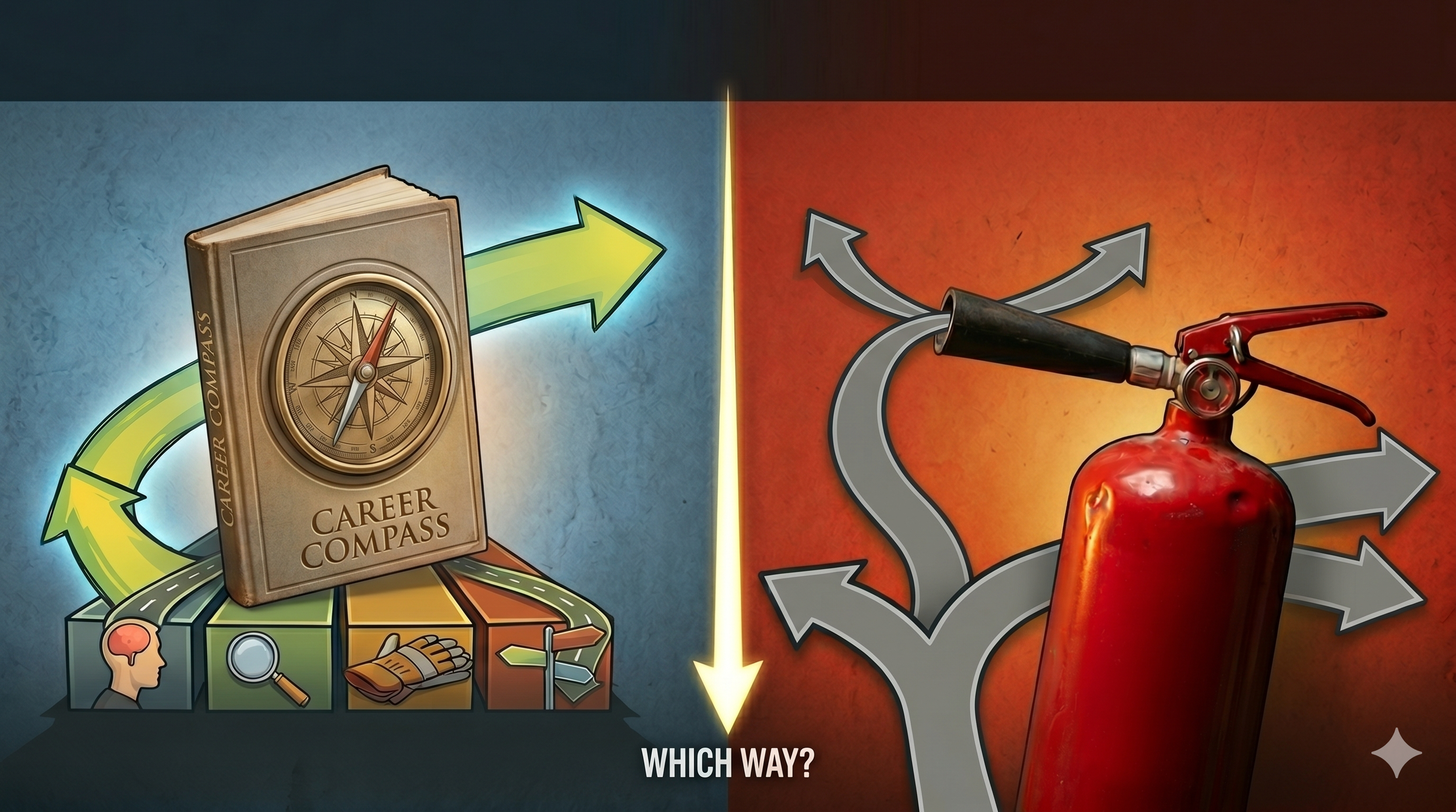
But career exploration? We treat it like a fire extinguisher. Only useful when something is already on fire.
It does not have to work this way.
The tools exist. The research exists. A structured, honest process for understanding yourself before you commit to a path, whether that path leads to a campus, a job site, a trade program, or something else entirely, is not a luxury. It is the foundation that every other career decision should be built on. And it is available to anyone willing to do the work before the crisis arrives.
That is what Career Compass: A Guide to Career Exploration was written to provide. A complete four-part process: understanding yourself, researching your options, getting real-world exposure, and making a decision that is genuinely yours. Not what pays well on paper. Not what your parents want. Not what your best friend is doing. What actually fits who you are.
The exploration has to come first. Everything else follows.
Plan Ahead. Find Your Way. It’s Better than Putting Out Fires.FAQ
Why is career exploration important before choosing a career? Career exploration helps you understand who you are and what kind of work actually fits you before you commit to a path. Without it, people often pick what seems safe, what their parents suggest, or simply what is available. Exploring first is the foundation every other career decision should be built on.
Is it common for college students to change their major? Yes. A 2024 study by the American Academy of Arts and Sciences found that 47 percent of college students changed their primary major at least once before finishing their degree. Each change can add time, money, and often more debt.
What are the steps of career exploration? Career Compass: A Guide to Career Exploration lays out a four-part process: understanding yourself, researching your options, getting real-world exposure, and making a decision that is genuinely yours. The goal is not what pays well on paper or what others want for you. It's what actually fits who you are.